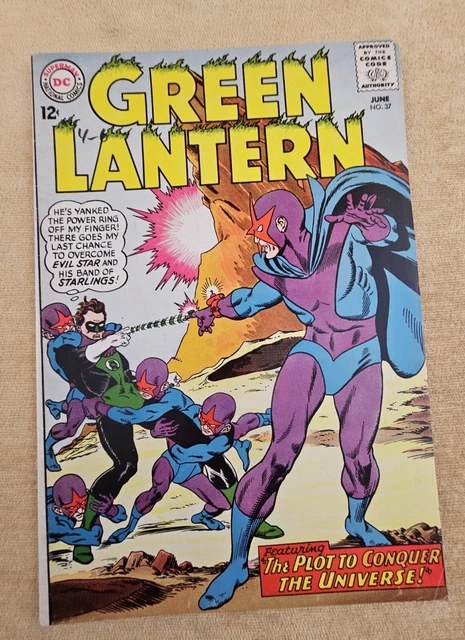
The immortal tyrant of the Starband.
Evil Star
On the planet Aoran, a scientist dedicated himself to cheating death by drawing power from the stars themselves. He invented the Starband — and it made him immortal, but it twisted his mind toward evil and prematurely aged his fellow Aorans. When his people begged him to destroy it, he refused; when they tried to take it, he killed them. All of them. Some 2.5 billion souls — he even watched with glee as his own wife and child aged and died before his eyes. The scientist was gone. Only Evil Star remained, first appearing in Green Lantern vol. 2 #37 (June 1965, Gardner Fox and Gil Kane).
Evil Star became one of Hal Jordan's most persistent Silver Age foes, commanding the Starlings — savage, super-strong minions powered by the Starband — in his quest to conquer new worlds. The Guardians eventually sent him to the Erral Rehab Facility, where a brainwave nullifier only partially cured him: it stimulated his subconscious, recreating the Starlings, who brought him the Starband and set him loose again. He clashed with the Darkstars and Guy Gardner (who learned the hard way that the adorable-looking Starlings can be murderously savage), and was freed by Neron during Underworld Unleashed before being returned to captivity.
His shadow falls across the modern mythos too: Evil Star was the guiding force behind the Kroloteans abducting William Hand and searching his insides for the blackness that would lead to the Blackest Night (Green Lantern vol. 4 #43), and Sister Sercy of the Blue Lantern Corps named him a menace to her homeworld. In Grant Morrison and Liam Sharp's The Green Lantern #2 (2018), slavers freed him from the starless Obsidian Deeps and tore away the Starband — and without it, Evil Star rapidly aged and died, feeling guilt and remorse at last. He was later revealed to have survived. Immortality, it turns out, is harder to kill than its bearer.
Keep exploring
Photograph of Green Lantern #37 (1965). Cover credited by DC to Gil Kane and Murphy Anderson; photographer unknown. Gil Kane (cover artist (publisher credit)); Murphy Anderson (cover artist (publisher credit)). Artwork source & details.