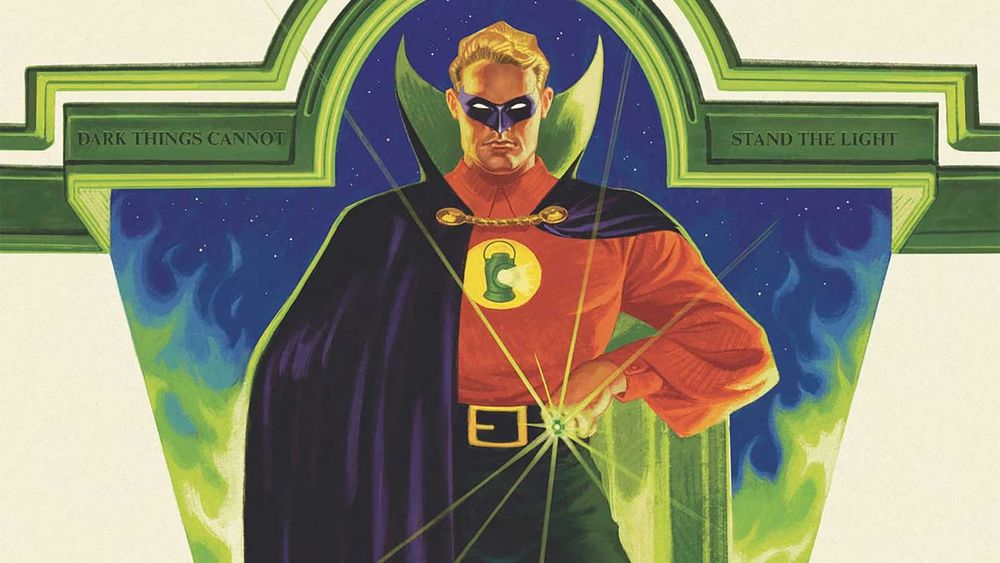
Existing site Alan Scott illustration; not the cover of All-American Comics #16.
Green light, different lineage
Alan debuted in All-American Comics #16 (1940), nineteen years before Hal Jordan's first appearance. He is a founding member of the Justice Society, with a ring that focuses magical green fire. He did not begin as a recruit assigned to a sector by the Guardians. This distinction matters whenever a page discusses Corps rules: a shared name and color do not make every Lantern's powers interchangeable. DC's Alan Scott profile identifies his debut and affiliation.
The Starheart supplies a magical branch of the mythology. Later writers connected it to the Guardians' history, while Alan's adventures retained their own supporting world. Treat that connection as an expansion of an older concept, not evidence that the 1940 comic already contained the modern emotional spectrum. DC's publication retrospective separates the original flame from the later explanation.
Origin spoilers: how Alan makes his ring
A mysterious green flame protects engineer Alan Scott when his train is wrecked. The flame inhabits a lantern; Alan fashions a ring from its metal and uses the new power against the person responsible. His traditional magical powers include flight and effects quite unlike the later Corps' standard toolkit. The old weakness to wood also belongs to this magical tradition; it is not the Corps' yellow impurity. DC's Alan history explains the origin and powers.
Keep the incarnations separate
Golden Age / Justice Society Alan: the original hero and Starheart legacy, later revisited in team stories and modern retellings. This page and his profile center on that lineage.
The New 52 Earth 2 Alan: a younger alternate incarnation associated with the elemental Green. His version of the origin and personal history should not be substituted for the JSA hero's. DC explicitly distinguishes this counterpart.
Alan Scott: The Green Lantern (2023–2024): Tim Sheridan and Cian Tormey revisit the JSA hero's past through a new personal mystery. It is a modern recontextualization, not the 2012 Earth 2 launch. DC's series announcement describes that approach.
Three ways to read the legacy
For the original artifact, read All-American Comics #16. For the meeting of Lantern generations, Justice League of America #21–22 brings Alan and Hal together in a Justice Society / Justice League team-up, as documented in DC's linked retrospective. For a contemporary entry, the Alan Scott: The Green Lantern collection includes #1–6 plus the short story from DC Pride: Through the Years #1.
Choose by interest rather than treating all three as compulsory homework. Then explore Hal's classic social-justice stories or return to the classics route. Publication dates here identify when readers encountered a story; they are not an exact in-universe calendar.
Scope: the original / JSA lineage, with alternate-incarnation distinctions. Sources reviewed November 4, 2026.
Artwork credits (1 image)
Credits refer to the illustrations shown here. Open a record for sources, adaptations and unresolved details. Some artwork and source pages contain story spoilers.
Alan Scott — Alan Scott: The Green Lantern #1 (2023), David Talaski cover, cropped detail. David Talaski (cover art).